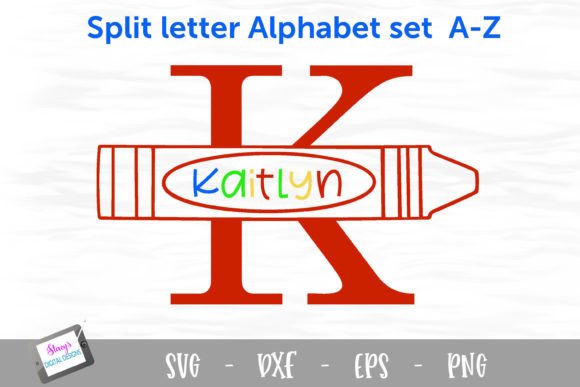
Crayon Monograms - Split Letters A–Z
Crayon Monograms - Split Letters A–Z is a digital design collection consisting of 26 individual uppercase letters, each stylized to resemble hand-drawn crayon marks and segmented into two distinct parts—typically a top and bottom section—that can be layered, spaced, or rearranged. The set includes one file per letter in four widely used vector and raster formats: SVG, PNG, DXF, and EPS. It is marketed primarily for crafters, educators, and hobbyists who use cutting machines (such as Cricut or Silhouette), graphic design software (like Adobe Illustrator or Inkscape), or print-and-cut workflows.
This resource supports projects where visual playfulness and tactile appeal matter—especially those targeting children or evoking a nostalgic, handmade aesthetic. Unlike continuous monogram fonts or solid-letter graphics, the “split” structure invites customization: users can adjust spacing between segments, recolor each half independently, or offset layers to create shadow or depth effects.
Who Might Consider Crayon Monograms - Split Letters A–Z?
Educators preparing back-to-school materials may find value in the set’s clarity and child-friendly styling. Teachers often seek printable name tags, classroom labels, or bulletin board accents that feel approachable and age-appropriate—particularly for early elementary settings. Similarly, parents organizing personalized school supplies (lunchboxes, notebooks, folders) may appreciate having ready-to-cut letters that avoid overly ornate or adult-oriented designs.
Crafters using cutting machines for custom apparel, wood signs, or vinyl decals also represent a core audience. The split layout allows for techniques like layering contrasting colors or applying different textures (e.g., glitter vinyl on the top segment, matte vinyl on the bottom). Designers working on invitations, party decorations, or nursery art may use the files as modular elements rather than static monograms—repositioning halves to fit irregular layouts or scale constraints.
Practical Benefits and Realistic Expectations
The inclusion of multiple file types improves compatibility across platforms and devices. SVG files support web use and most modern cutting machine software; DXF files are widely accepted by older or CAD-based systems; EPS offers scalability in professional print environments; PNG files provide transparent-background raster versions suitable for digital overlays or basic print projects without vector editing capability.
However, users should verify format compatibility with their specific hardware and software before purchase. For example, some budget-grade cutting machines lack native EPS support, and certain free design tools do not import DXF reliably. Likewise, while SVG files are broadly supported, version differences (SVG 1.1 vs. SVG 2.0) may affect rendering fidelity—especially with embedded effects or complex paths.
The set does not include lowercase letters, numerals, punctuation, or ligatures. Users needing full alphabetic coverage beyond A–Z—or requiring multilingual characters—will need supplemental resources. Also, because each letter is pre-designed as a split graphic rather than a font, dynamic text generation (e.g., typing “Sarah” and auto-generating matching letters) is not possible. Each monogram must be assembled manually by selecting, sizing, aligning, and grouping individual files.
Situations Where This Set Fits Well
Crayon Monograms - Split Letters A–Z works best when the goal is intentional, small-batch personalization—not mass production or rapid iteration. It suits scenarios such as:
- Creating individualized first-day-of-school keepsakes (e.g., framed name art with crayon-style letters)
- Designing reusable classroom visuals where visual consistency and recognizability matter more than typographic flexibility
- Producing limited-run merchandise—like tote bags or mugs—for a single event or small group—where manual assembly of 2–5 letters is manageable
- Supporting learning activities focused on letter recognition, segmentation, or fine motor skills through physical manipulation of cut pieces
In these cases, the deliberate, hands-on nature of working with discrete split letters becomes an asset—not a limitation.
When Alternatives May Be More Appropriate
If your workflow prioritizes speed, scalability, or typographic control, other options may better serve your needs. For instance:
- TrueType or OpenType fonts allow instant typing, kerning adjustments, and responsive scaling—but lack the built-in segmentation and crayon texture unless manually applied via layering or effects.
- Modular letter systems with drag-and-drop interfaces (e.g., some Cricut Design Space assets or Canva templates) reduce setup time but may offer less creative freedom in layering or exporting.
- Custom illustration services provide tailored aesthetics and exact technical specifications—but at higher cost and longer turnaround times.
Similarly, if your project requires accessibility considerations—such as high-contrast variants, dyslexia-friendly shapes, or screen-reader compatibility—the static nature of these graphic files means additional adaptation would be necessary.
Making an Informed Decision
Before acquiring Crayon Monograms - Split Letters A–Z, consider three practical questions:
- What is your primary output method? If you rely heavily on print-only workflows or mobile apps with limited file support, confirm that at least one included format (e.g., PNG or SVG) integrates smoothly into your existing pipeline.
- How many unique monograms do you plan to produce? Manual assembly remains efficient for fewer than ten variations. Beyond that, evaluate whether template-based automation or font-based solutions would save time over the long term.
- Does the visual style match your intended audience and context? While the crayon aesthetic reads warmly and accessibly, it may not suit formal branding, corporate communications, or older student materials where maturity or neutrality is preferred.
Also note that licensing terms—often included in the zip folder’s documentation—dictate permitted uses. Most personal and small-business licenses allow physical product creation but restrict redistribution of the source files or use in digital resale items (e.g., editable Canva templates). Review those terms directly, as they vary by seller and platform.
In summary, Crayon Monograms - Split Letters A–Z offers a focused, stylistically cohesive solution for specific creative and educational applications. Its strength lies in intentional design and multi-format accessibility—not versatility or automation. Readers evaluating this resource should weigh their technical environment, volume expectations, and stylistic goals against alternatives that emphasize speed, scalability, or broader character sets.