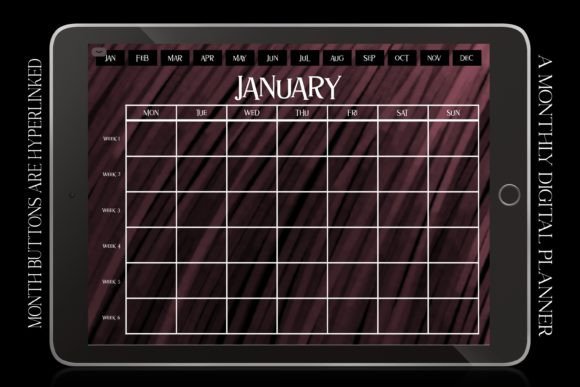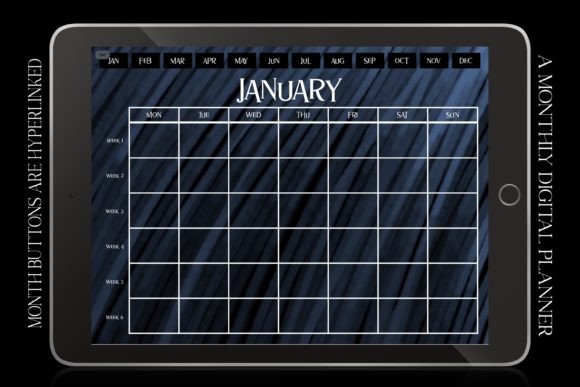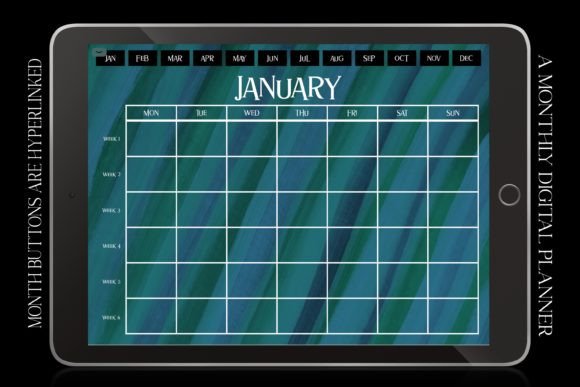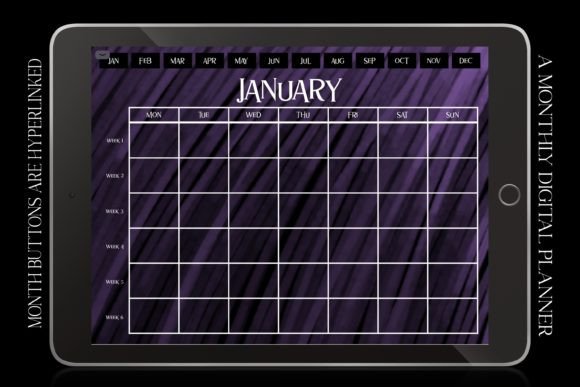
Purple Monthly Digital Calendar Planner
If you’ve ever scrolled past another generic digital planner—flat, cluttered, or visually exhausting—you’ll instantly recognize the quiet confidence of the Purple Monthly Digital Calendar Planner. It’s not just a calendar. It’s a calm, intentional space: minimalist yet rich in character, retro-inspired but thoroughly modern in function. Designed for people who plan deeply—not just to fill time, but to honor it—the planner features a horizontal landscape layout with six weeks per month, Monday start, and undated flexibility so you can begin anytime, pause, reset, or revisit without friction.
Visually, it leans into an elegant dark-night mode: deep black or charcoal backgrounds layered with soft violet tones—think dusk-lit lavender fields or vintage film stock washed in indigo. The typography is crisp, refined, and intentionally restrained—thin white serif lettering that nods to mid-century editorial design, not flashy display fonts or overworked scripts. There’s no noise, no forced whimsy. Just clean lines, generous whitespace, and subtle textural cues—a faint grain or paper-like texture in the background—that whisper “vintage” without shouting it. Halloween, Christmas, and New Year motifs appear only as delicate, classically rendered icons or muted border accents—never cartoonish, never kitschy. This isn’t seasonal decoration; it’s atmospheric continuity.
A Planner That Fits Your Workflow—Not the Other Way Around
This isn’t a one-size-fits-all template. The Purple Monthly Digital Calendar Planner was built for real tools, real habits, and real constraints. Whether you’re sketching meal prep in GoodNotes on an iPad Pro, annotating client deadlines in Notability, mapping content calendars in OneNote, or tracking fitness milestones in Xodo on an Android tablet, the layout stays legible and functional at any zoom level. Its horizontal orientation gives you breathing room—no frantic scrolling, no cramped grids. You see the full month *at a glance*, yes—but more importantly, you see your priorities *in context*: how that team meeting lands beside your yoga block, where your creative hour fits between school pickups and grocery runs, how your self-care ritual anchors the week instead of floating unmoored.
Because it’s undated, it adapts to your rhythm—not the calendar’s. Missed a week? No penalty. Started mid-month? No rework. Need to duplicate January three times for quarterly planning? Done. Teachers use it to map lesson themes across terms. Entrepreneurs layer in product launches, cash flow checkpoints, and outreach cadences. Students stack assignment deadlines against exam windows and part-time shifts. Even side-hustlers find clarity here: separating passion projects from admin work, tracking NanoWriMo word counts alongside freelance invoices, or aligning social media batches with content pillars—all without visual overload.
Why This Aesthetic Works—Beyond “Pretty”
That purple-black-vintage palette isn’t just decorative—it’s cognitive scaffolding. Dark mode reduces eye strain during long planning sessions, especially in low-light environments (hello, 10 p.m. goal review). The violet undertone adds warmth without glare; it’s easier on the retina than stark white-on-black, and more grounded than bright purples that vibrate. Paired with thin, high-contrast white serif text, readability remains exceptional—even at smaller font sizes used for notes or habit trackers. Serifs lend authority and quiet sophistication, subtly reinforcing intentionality. You’re not skimming. You’re committing.
This aesthetic also signals consistency across your digital ecosystem. If your brand identity uses muted palettes, archival textures, or editorial restraint—this planner doesn’t clash. It extends your visual language into daily practice. For content creators, marketers, or publishers, that cohesion matters: your planning tool becomes part of your creative infrastructure, not a visual outlier. And because it avoids trendy gradients, neon accents, or animated elements, it won’t feel dated next season. It’s built to last—like a well-bound journal, not a disposable app notification.
Practical Integration Tips—No Design Degree Required
You don’t need to be a typographer to use this well—but a few mindful choices elevate it fast:
- Pair wisely: Use the planner’s built-in serif for headers and dates, then switch to a neutral sans serif (like Inter or SF Pro) for typed notes or checklists—clean contrast without competition.
- Leverage whitespace: Don’t overcrowd cells. Let the grid breathe. Use bullet points, symbols (✓, ⚡, 🌙), or light color-coding (via app highlighting tools) to differentiate categories—meetings vs. habits vs. personal time—without altering the base design.
- Test before scaling: Import a sample page into your preferred app at actual size (e.g., iPad Pro 12.9” landscape). Zoom to 75% and 150%. Does the text remain sharp? Do icons retain clarity? Adjust stroke weight or spacing in-app if needed—but keep the core aesthetic intact.
- License with intent: This is a commercial-use digital asset. Whether you’re gifting it to clients, bundling it into a course for university students, or offering it as a branded resource for your coaching practice—check the license terms. Most versions include extended rights for small business use, but always verify scope before redistribution.
Making It Meaningful—For Gifting, Teaching, and Everyday Grace
It’s become a quietly beloved gift—not because it’s flashy, but because it’s *seen*. A student receiving it before finals knows their professor values their mental bandwidth. A new entrepreneur gets it as a “first tool” from a mentor who understands that clarity precedes execution. Parents homeschooling through uncertain seasons appreciate its adaptability—no rigid school-year assumptions, just space to build routine around real life. Even crafters and hobbyists use the margins for sketching, stitching charts, or ingredient notes—its structure supports creativity, not suppresses it.
What makes the Purple Monthly Digital Calendar Planner endure isn’t novelty—it’s resonance. It meets people where they are: overwhelmed, aspirational, detail-oriented, or simply tired of choosing between beauty and utility. It doesn’t ask you to optimize yourself to fit the tool. It asks only that you show up—and gives you a calm, elegant, deeply functional place to begin.