Yearly Budget Review Tracker Logbook
If you're juggling income, expenses, savings goals, and quarterly reviews — but still flipping between spreadsheets, sticky notes, and half-filled notebooks — the Yearly Budget Review Tracker Logbook is built for that exact moment of clarity. It’s not another generic planner. It’s a purpose-built, print-ready logbook designed for intentionality: 120 pages of structured yet flexible space to map, monitor, and reflect on your financial year — without digital distraction or setup friction.
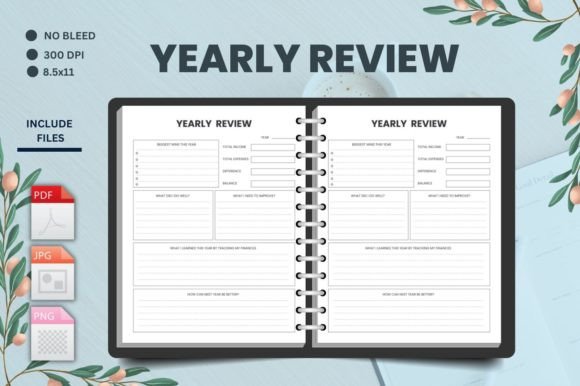
Visually, it strikes a quiet balance: clean layout, generous margins, subtle grid lines (light gray, 10% opacity), and consistent spacing that supports both handwriting and light annotation. There’s no loud color blocking or decorative flourishes — just thoughtful geometry, ample white space, and a rhythm that guides your eye naturally from monthly overviews to expense breakdowns to annual summaries. The aesthetic leans into calm professionalism: pastel-adjacent but not cutesy, organized but not rigid, personal but never childish. It feels like a tool you’d keep on your desk next to a well-sharpened pencil and a favorite pen — functional first, beautiful second.
Where This Logbook Fits in Real Creative Workflows
This isn’t just for personal finance tracking. Designers use it as a production reference when managing client retainer cycles. Small business owners treat it as a lightweight alternative to complex accounting software for high-level cash flow awareness. Content creators align it with content calendars to match budget allocations to campaign timelines. Bloggers pair it with editorial calendars to track ad revenue vs. affiliate spend per quarter. Even crafters and hobbyists use it to plan material purchases, craft fair booth fees, and Etsy fee projections — all in one place, on paper.
The 8.5″ × 11″ size isn’t arbitrary. It’s the sweet spot for KDP publishing — no bleed, perfect interior trim, and fully tested across Amazon’s upload system. That means if you’re a publisher building a suite of productivity tools, this logbook integrates cleanly into your catalog. No reformatting. No pixel-perfect panic at upload time. Just drag, drop, and go — backed by real KDP validation, not theoretical compatibility.
More Than Pages — A System You Can Trust
Inside the 120-page interior, you’ll find a progression that mirrors how thoughtful budgeting actually unfolds: starting with an annual snapshot, moving into monthly trackers (income, fixed expenses, variable spending, savings contributions), then rolling into quarterly review prompts — not just “What did I spend?” but “What shifted? What surprised me? What do I carry forward?” There are dedicated spaces for goal mapping, debt payoff tracking, and even a simple net worth log — all designed to be filled in by hand, reviewed at pace, and referenced meaningfully months later.
The included JPG, PNG, and 300 dpi PDF aren’t afterthoughts. They’re production-ready assets: the JPG for quick social previews, the PNG for transparent overlays in Canva or Figma mockups, and the PDF for direct printing or professional binding. All maintain crisp edges and accurate sizing — no fuzzy text, no off-center margins. That consistency matters whether you’re sharing a sample image on Instagram or prepping files for a local print shop.
Design Decisions That Support Real Use
Readability here isn’t about font size alone — it’s about contrast, line height, column width, and visual breathing room. The logbook uses a measured 12 pt base with 1.45 line spacing and 2.5″ left/right margins. Why? Because most adults write larger than they think — especially when reviewing numbers under low-light conditions or after a long day. Narrow columns reduce eye fatigue during extended review sessions. Light grid lines provide guidance without competing for attention. And the absence of bleed? It’s not just technical — it means every page looks intentional when printed, bound, or scanned.
For designers evaluating fit: test it alongside your existing brand fonts. If your identity relies on a strong sans serif (like Inter or Montserrat), this logbook’s neutral structure won’t clash — it’ll complement. If you lean into warm serifs (Cormorant Garamond, Lora), the clean layout creates elegant contrast. And if you work with script or handwritten elements, the logbook’s restraint gives those expressive touches room to shine — no visual competition.
Practical Tips Before You Publish or Print
- Test before bulk orders: Print one full spread — especially the quarterly review section — using your intended paper stock. Does ink bleed? Is the grid visible but unobtrusive? Does the margin feel generous enough for binding?
- Pair intentionally: If bundling with other planners or journals, ensure cover textures, spine widths, and interior paper weights align. Consistency builds perceived quality — even if buyers never consciously notice it.
- Licensing is covered: This is a commercial-use asset. You can sell printed copies, bundle it digitally, or include it in subscription boxes — no attribution required, no hidden restrictions.
- Think beyond “budget”: Tag it smartly on marketplaces — yes, with “budget planner” and “finance logbook,” but also “annual review template,” “small business tracker,” and “printable organizer.” Real users search for outcomes, not categories.
Finally, remember: the best productivity tools don’t demand perfection — they support progress. The Yearly Budget Review Tracker Logbook doesn’t assume you’ll update it every Sunday at 7 a.m. It assumes you’ll open it when it matters — after a big purchase, before tax season, or mid-year when things feel off-track. That’s where its value lives: not in flawless execution, but in honest, repeatable reflection. And that kind of grounded utility? That’s what turns a notebook into a trusted part of someone’s workflow — year after year.