Pen Control Trace Color Book for Kids
For educators preparing back-to-school materials, indie publishers launching on KDP, or parents seeking screen-free developmental tools—this Pen Control Trace Color Book for Kids delivers focused, ready-to-use value. It’s not another generic activity pack. It’s a purpose-built 16-page workbook designed around one core developmental milestone: the transition from scribbling to intentional mark-making. That shift—where a child begins to control line direction, pressure, and shape fidelity—is foundational for handwriting readiness, visual discrimination, and even early math reasoning.
Why Pencil Control Matters Before Letters Even Appear
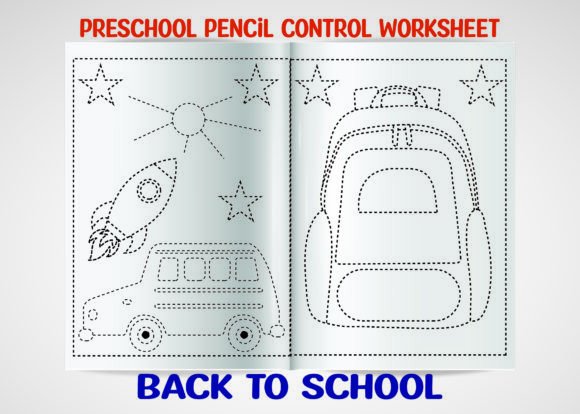
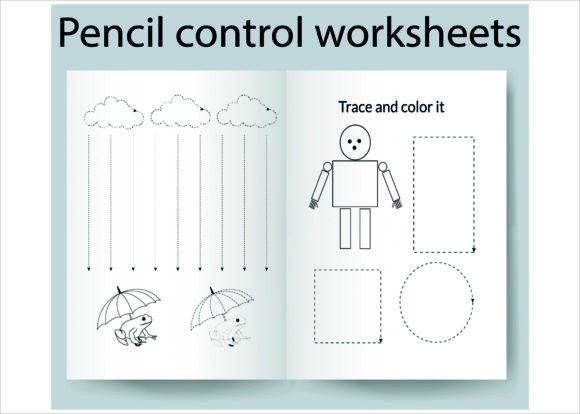
Many well-intentioned adults jump straight to letter tracing—but research in early childhood education shows that stable pencil control develops *before* symbol recognition. Without it, children compensate with awkward grips, excessive pressure (leading to fatigue or broken pencil tips), or avoidance. The Pen Control Trace Color Book for Kids sidesteps that gap by isolating lines and shapes: straight lines, curves, zigzags, circles, squares, triangles, and stars. Each page builds complexity incrementally—starting with guided strokes along thick borders, then moving toward freer tracing within defined boundaries. This scaffolding mirrors how occupational therapists structure fine motor intervention—not as “practice,” but as targeted neuromuscular training.
Designed for Real-World Use—Not Just Theory
The 8.5 x 11 inch format isn’t arbitrary. It matches standard printer trays and classroom copy machines, eliminating scaling errors or cropping during bulk printing. Every page is print-ready PDF—no fonts to embed, no layers to flatten, no color profiles to adjust. For KDP creators, that means faster upload cycles and fewer formatting rejections. For teachers, it means pulling up the file before homeroom, hitting “print,” and handing out crisp, high-contrast pages—even on economy paper. The included PNG and JPG source files (one per page) also allow easy integration into digital learning platforms like Seesaw or Google Slides for hybrid instruction—just insert, annotate, and assign.
Where Confidence Grows From Repetition—Not Perfection
Notice what’s *not* included: timed drills, red pen corrections, or comparative scoring. Instead, each shape includes subtle visual cues—like directional arrows or segmented outlines—that guide hand movement without dictating speed or pressure. Children trace, then color the same shape using crayons or markers. That dual-action—tracing *then* coloring—reinforces muscle memory while offering immediate creative agency. A 4-year-old doesn’t need to know they’re building finger isolation; they just feel proud that their circle looks “full” and “bright.” That intrinsic motivation is what sustains practice far longer than external rewards ever could.
Who Benefits Most—and How They Use It Differently
Educators Pre-K–K: Use pages as warm-up stations during morning routines—3 minutes of tracing before circle time builds focus and hand activation. Pair with verbal prompts (“Push your pencil gently down… now lift and slide across”) to reinforce spatial language.
KDP Publishers: This isn’t a standalone bestseller—it’s a strategic entry point. Bundle it with a matching “First Words Tracing Book” or “Color & Count Activity Pack” to increase average order value. Because all assets are provided in layered, editable formats (PDF + PNG + JPG), you can rebrand colors, add your logo to corner watermarks, or localize instructions—all without design overhead.
Parents & Homeschoolers: Keep it accessible—not in a drawer, but clipped to a small clipboard beside the kitchen table. Use during quiet afternoons when screens are off-limits. The 16-page count is intentional: long enough to show progression over weeks, short enough to avoid overwhelm. One parent reported using just two pages per week—tracing on Monday, coloring on Friday—to create rhythm without pressure.
Practical Considerations—Not Just Promises
This workbook excels at its specific scope: pre-writing shape mastery. It does *not* teach letter formation, phonics, or number recognition—nor does it claim to. If your goal is comprehensive kindergarten prep, pair it with resources focused on auditory processing or number sense. Likewise, while the high-contrast black-and-white lines suit most learners, children with low vision may benefit from enlarged versions or tactile overlays—something the source files make easy to adapt.
Also note: The simplicity is deliberate. There are no cartoon characters, storylines, or themed distractions. That’s an advantage for children who become overstimulated by busy pages—but a limitation if engagement relies heavily on narrative or humor. In those cases, consider using this as a “foundation builder” for 10 minutes daily, followed by a more imaginative coloring book.
How It Fits Into Broader Developmental Goals
Fine motor development isn’t isolated—it connects directly to attention regulation, self-expression, and academic stamina. When a child learns to control a pencil through repeated, successful tracing, they’re also practicing impulse control (staying inside the line), visual tracking (following the path with eyes), and bilateral coordination (holding the paper steady with one hand while drawing with the other). These aren’t “extra” skills—they’re prerequisites for sitting through a 20-minute read-aloud or copying a spelling word from the board.
One kindergarten teacher shared how she used the Pen Control Trace Color Book for Kids alongside clay work and scissor practice. After four weeks, 82% of her students demonstrated improved pencil grip stability—measured not by checklists, but by reduced fatigue during writing tasks and fewer requests to “rest my hand.” That kind of observable, classroom-validated outcome reflects how tightly aligned the activities are with developmental sequencing.
A Resource That Scales With Your Needs
Because it’s delivered as print-ready PDF plus individual image files, usage isn’t locked to one medium. Print double-sided for take-home packets. Upload single pages to a tablet for stylus tracing. Convert PNGs to SVG for laser-cut stencils in makerspace labs. Even speech-language pathologists have repurposed the shape outlines for articulation practice—naming shapes while producing target sounds (“Say ‘circle’ with your lips rounded”). Its flexibility comes from constraint: by focusing deeply on one skill, it avoids dilution.
If you’re evaluating early learning tools, ask: Does it meet a clear developmental need *before* formal instruction begins? Does it reduce setup time without sacrificing quality? Does it empower the adult—whether teacher, creator, or caregiver—to adapt, extend, or integrate without technical friction? The Pen Control Trace Color Book for Kids answers yes to all three—not as marketing claims, but as built-in design outcomes.