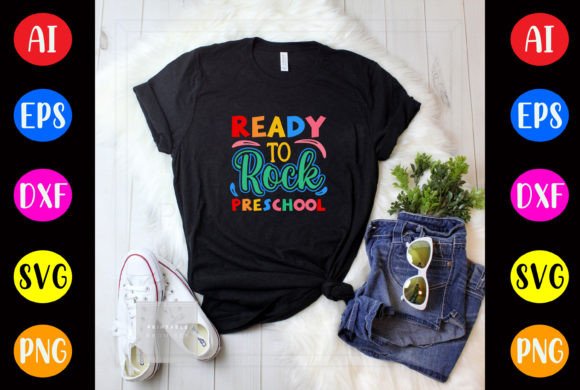
Ready to Rock Preschool T-shirt Design
If you're preparing for the new school year—whether you're a teacher stocking up for classroom spirit days, a parent organizing a preschool fundraiser, or a small-batch merch creator launching your first kids' apparel line—you’ll appreciate how much time and energy goes into finding a design that’s both joyful and functional. The Ready to Rock Preschool T-shirt Design isn’t just another clipart-style graphic. It’s a thoughtfully built, print-ready asset created with real-world use in mind—not just aesthetics.
What You’re Actually Getting
This isn’t a low-res JPEG dragged from a free stock site. Inside the instant-download ZIP folder, you’ll find multiple industry-standard file formats: AI (Adobe Illustrator), EPS, SVG, DXF, and high-resolution PNG—all sized at 4500×5400 pixels and set in RGB color mode. That means whether you’re using a home Cricut machine, a professional DTG printer, or a local screen-printing shop, the files scale cleanly and retain crisp edges at any size.
The design itself features bold, friendly typography paired with playful, age-appropriate iconography—think cheerful stars, chalkboard textures, and rounded letterforms that feel warm and inclusive. It avoids overused tropes (no cartoon dinosaurs holding apples here) while still communicating energy, readiness, and early learning joy. And because it’s vector-based, changing colors takes seconds—not hours—whether you want navy shirts for a summer camp or pastel pinks for a girls’ group photo day.
Why Educators Reach for This Design
For preschool teachers and childcare coordinators, consistency matters. A unified look across t-shirts helps build belonging—especially for children who thrive on visual cues and routine. One educator in Portland used this design to create matching shirts for her “Welcome Week” activities, printing them on soft cotton tees for staff and volunteers. She adjusted the color palette to match her classroom’s calming blue-and-yellow theme, then printed name tags directly onto the back using the same file—no extra design work needed.
What matters most to educators isn’t flashy effects or trendy fonts—it’s clarity, accessibility, and ease of adaptation. They need something that works for toddlers (large, legible elements), aligns with licensing or district branding guidelines (hence the clean vector format), and doesn’t require technical know-how to tweak. The fact that this file includes transparent PNGs—ready for quick mockups in Canva or Google Slides—means they can preview it on a shirt image before ordering, reducing costly reprints.
How Small Business Owners and Creators Use It Differently
A freelance designer in Austin uses this file as a starting point for custom client projects—not as a final product. She imports the AI version into Illustrator, swaps out the background motif for a hand-drawn tree silhouette, adjusts spacing for toddler necklines, and exports fresh variants for different age groups (2T–5T). Because the layers are well-organized and labeled, she saves nearly two hours per revision.
Meanwhile, a mom-run Etsy shop owner bought the design to launch her “Back to School Bundle” listing. She bundled it with editable name tags and a printable welcome poster—all using consistent colors and fonts. Her customers appreciated being able to change the text (“Emma’s First Day!”) and pick their own shirt color without needing software. That flexibility translated directly into fewer support messages and higher review scores.
Beginners vs. Experienced Users: What Changes?
Beginners often prioritize simplicity and confidence. If you’ve never opened Illustrator before, the SVG and PNG files let you drop the design straight into Cricut Design Space or Canva. You can change colors with one click, resize without distortion, and skip the learning curve entirely. There’s no need to understand paths or nodes—just drag, adjust, and print.
Experienced users care more about precision and scalability. They’ll open the AI file to fine-tune anchor points, convert text to outlines for commercial printing, or separate layers for multi-color screen printing. The inclusion of DXF makes it compatible with laser cutters and vinyl plotters—useful if you’re making iron-on transfers or fabric appliqués. The 4500×5400 pixel resolution ensures sharpness even on oversized tote bags or wall decals.
What “100% Satisfaction” Really Means Here
It’s not marketing speak. It reflects how the file was built: with fallback options, clear naming conventions, and no hidden raster elements masquerading as vectors. If your printer asks for CMYK, you can convert the RGB file yourself—no loss of quality. If your platform only accepts PNG, the transparent version is ready. If you need to add a school logo beside the design, the generous canvas gives you breathing room.
That reliability shows up differently depending on your role. For a homeschool parent planning a co-op field trip, it means peace of mind knowing the design won’t pixelate when scaled for a group photo banner. For a church volunteer coordinating VBS shirts, it means being able to hand off the file to a teen helper with minimal instruction—and still get professional-looking results.
When This Design Fits—and When It Might Not
This is ideal if you value speed without sacrificing quality—if your goal is to go from idea to printed shirt in under an hour, not three days of trial and error. It’s especially helpful when you need consistency across multiple items (shirts, stickers, tote bags, digital newsletters) and want to maintain brand cohesion without hiring a designer.
It may not be the best fit if you need photorealistic illustrations, licensed character art, or highly customized typography where every letter needs bespoke kerning. Likewise, if your project requires strict adherence to a specific brand guide with Pantone-matched inks, you’ll want to verify color accuracy on your end before large runs—but the included RGB base gives you full control to adjust.
Practical Next Steps
- Teachers: Import the SVG into Canva, add your class name and start date, and generate a PDF for your local print shop.
- Crafters: Load the DXF into Cricut Design Space, mirror the design for iron-on vinyl, and cut in under five minutes.
- Small business owners: Use the AI file to create variations—swap icons, add slogans, or build a full “Back to School” collection with coordinated designs.
- Parents: Open the PNG in any photo editor, type your child’s name, and send the file to a print-on-demand service like Printful or Snapfish.
No matter your role, the Ready to Rock Preschool T-shirt Design meets you where you are—without assumptions about your software, budget, or experience level. It’s built to support action, not stall it.